21 April 2015

Then and now: In pictures

Here are some contrasting images to show how things have changed (and stayed the same) since our arrival in July 2014 and now, nine months later.

Streamers of Kurdistan flags appeared overnight on our street in early
August after the Islamic State group pushed into Kurdish-controlled
territory and prompted mass displacement.  Nationalism and morale
were high; people thought they would be returning to their homes in 
Mosul and the surrounding towns in a few weeks or months. 

The streamers are still there, less jaunty now and more bedraggled. [Insert war metaphor here.] 

--


Short hair.
Long hair.

--


Late July: dry, dusty, and hazy, post-wheat harvest.

Early March: green, clear(er) skies.

--


In the initial days and weeks following the Islamic State push, displaced people were everywhere -- along roadsides, in construction sites, in spare lots, in church yards and mosques.  Even though almost half of the IDPs fleeing to the Kurdistan region of Iraq immediately moved into houses, there was a huge visible presence of IDPs in every square meter of space.

As the conflict wore on, IDPs were increasingly concentrated into (less visible) camps and informal settlements, especially with "caravans" (pre-fab trailers).  This is Mar Elia IDP center at Christmas; now they have caravans instead of tents.

While there are camps, unfinished buildings are one of the most common places where IDPs have settled.  This is the inside of Ankawa Mall, which housed about 400 families.  Last week, they were moved into caravans on the outskirts of town.

--


Accidental matching shirts with Jim Fine, my predecessor as MCC Iraq program coordinator.

Intentional matching shirts with Nathan (and all forty choir members) for Easter.  


--


MCC office arrangement, July 2014.

MCC office arrangement, April 2015.


--


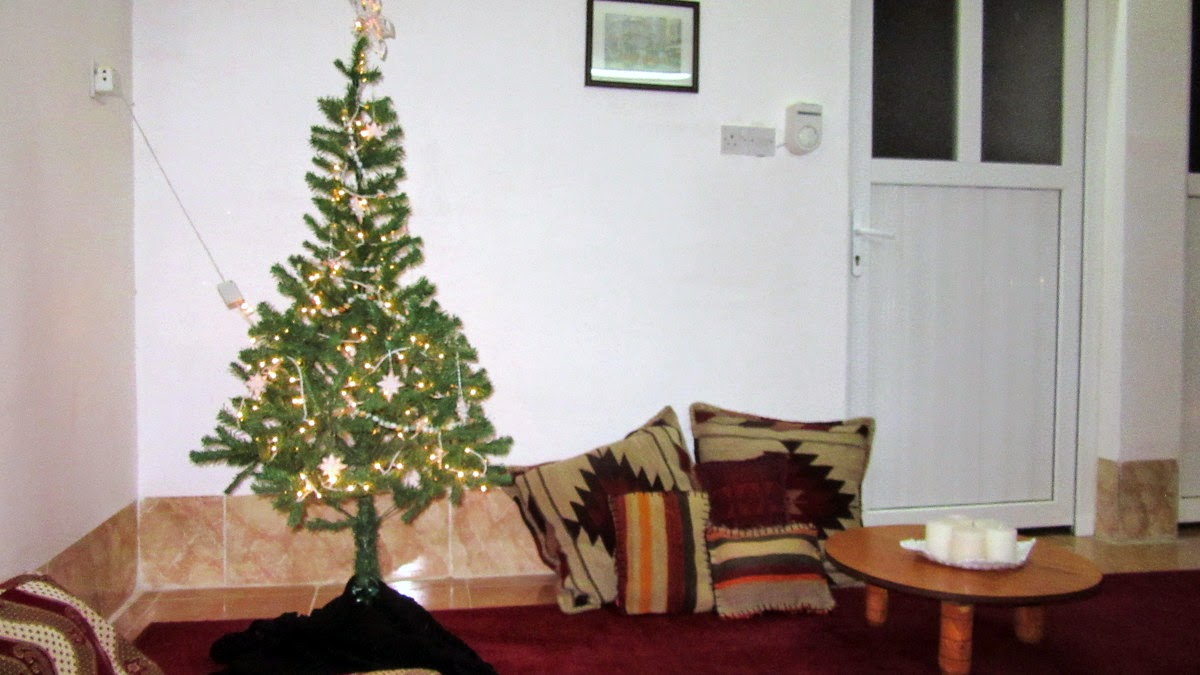
Traditional Kurdish pillow.
I cut off all the tassels in a fit of cultural insensitivity.
(For those of you who are planning a visit, make sure you keep room in your suitcase to take home a Kurdish rug, which are available in the Erbil bazaar.)


--

During our MCC Iran/Iraq/Jordan retreat in Jerash, Jordan (August).

On the roof of our house in Ankawa (February 2015).

04 April 2015

Daily bread

One of the big projects that MCC started this year in response to the ongoing crisis in Iraq is working with an Iraqi organization, ZSVP,  to provide six months of food (from March to August) for almost 700 families who fled from the Islamic State group last year and are living in two small towns in northern Ninewa governorate.

Photo credit: Abid Hassan, March 2015.

While I was collaborating with ZSVP and MCC staff in February to get the proposal off the ground and running, I learned that another international organization with funding from the World Food Programme (WFP) did a distribution in early February for the two towns that we were planning on targeting, with plans to continue with monthly distributions for as long as they had funding from WFP.

I pushed strongly to keep these two towns for ZSVP distributions instead of having them be absorbed into the broader WFP system.  I succeeded: these two towns were recognized by the coordination system as MCC/ZSVP's responsibility for March-August 2015.  I felt great; I took on the big system and got what I wanted, I advocated on behalf of our local partner, who would provide higher-quality food baskets than what WFP provides, and I avoided going back to the drawing board with the project design.  Win, win, win.

And then our implementation was delayed and didn't begin until March 30, instead of March 1.

As a result of my success, the regular supply of food for these families was delayed.  Instead of waiting four or five weeks between distributions, three thousand, nine hundred, and forty-eight people had to wait seven weeks, with only the assurance that it was coming to sustain them.  No one starved because of my actions---there are resources and safety nets beyond these food distributions that covered the gap---but people probably did go to bed hungry because of me.

--

I know that "if only"s have limited use.  I also don't know what other factors beside my personal decision to fight back contributed to this existing situation, or what other factors could have intervened in an alternate reality to delay the food distribution regardless.  However, I also know that I have sinned against thousands of people who I do not know, over whose food security I have arbitrary and extensive power.

Having a regular and predictable source of food is one of the main keys to not just surviving but thriving.  This is true not only for people in large-scale disasters like what's happening in Iraq and Syria now, but also for people in the United States and everywhere who are in the slow-motion crisis of poverty.  With this on my mind, I was struck by how receiving food is built right into Jesus' model of prayer, right after proclaiming the kingdom of God and before asking forgiveness for sins:  Your kingdom come on earth as it is in heaven.  Give us this day our daily bread. Forgive our sins.  Help us forgive others.

Our intentions are good, but that does not lessen the pain that we cause others. We see, think, and love imperfectly, and we are lucky if our best attempts come out even.  Nevertheless, we keep praying: give us this day our daily bread, and forgive us our sins as we forgive those who sin against us.

Photo credit: Chris Ewert, November 2014.

17 February 2015

Agriculture in the shadow of Daesh

The problems facing Iraq aren't all about the Islamic State group (known here as Daesh, the Arabic acronym).  The needs for improved agriculture, education, rule of law, and other systemic problems that existed before the crisis -- both natural and human-made -- are still here.  Similarly, although MCC's work has expanded to respond to the crisis, the long-term and ongoing work that it was doing before is still happening, and will continue into the future.

Among these ongoing projects, MCC currently partners with two Iraqi organizations (REACH and ZSVP) to improve the viability of small farmers and rural households by both increasing their production of vegetables, crops, and livestock and improving their access to reliable water resources.  REACH is working in Erbil and Suleimaniya governorates, while ZSVP is working in Dohuk and northern Ninewa governorates.  Some of these locations are very close to the front lines, while others are relatively isolated.  In the words of one project participant, "whether Daesh is near or far away, we are still just farmers with no money."

Shireen, a 56-year-old widow and head of a 10-person household, is from a village in Sinjar, very near the region that is controlled by the Islamic State group.  She received five beehives from ZSVP in February 2014.  "I harvested thirty kilos of honey in the end of July 2014.  I sold ten kilos for $25 each.  On 9 August, the terrorist groups controlled Sinjar and surrounded our village for about two months.  During this time we did not receive any support or help. So we benefited from the remaining honey production (twenty kilos) to feed our kids at that crucial stay, and I also helped my neighbors in the village.  So the project production was really a good income and supported the kids to survive."
Of the 25 beekeeping project participants in the Sinjar region, ZSVP has not been able to contact 14 since the Islamic State group advanced in August 2014.  (Photo credit: Dr Abid Hasan).

Joanna, a widowed mother of four girls and four boys, has doubled the size of her kitchen garden since ZSVP helped her establish it in early 2014, and she used the information from a training to create a makeshift greenhouse (at her feet) to start tomato and pepper seedlings.  She lives in a Yezidi village in the Kurdish-controlled region of Ninewa governorate, about 30 kilometers from territory controlled by the Islamic State group. 

The types of activities that take place through these projects are varied.  Direct agricultural activities include family kitchen gardens, community nurseries and greenhouses, beekeeping, backyard poultry, and tomato cultivation.  Water source protection and improvements include constructing irrigation channels and rainwater weirs, installing drip irrigation systems, and renovating water sources (like springs and shallow wells) and household plumbing systems.  Projects also include trainings for the participants on everything from how to divide and establish new bee swarms to particular regional pests that damage tomatoes.  ZSVP and REACH also work with the local communities to increase their collective organization and access to resources in general.  For example, the community-based organization (CBO) in Aly Zangan village (with the rainwater weir below) successfully advocated to the government to provide national electricity in their rural village.


The MCC learning tour visit in October 2014 observed the rainwater weir in Aly Zangana village soon after its construction was completed just before the onset of the rainy season.  Although the villagers were not sure how much water the weir would reserve, one said, "we will share the water until the last drop."  (Photo credit: Ruth Keidel Clemens).

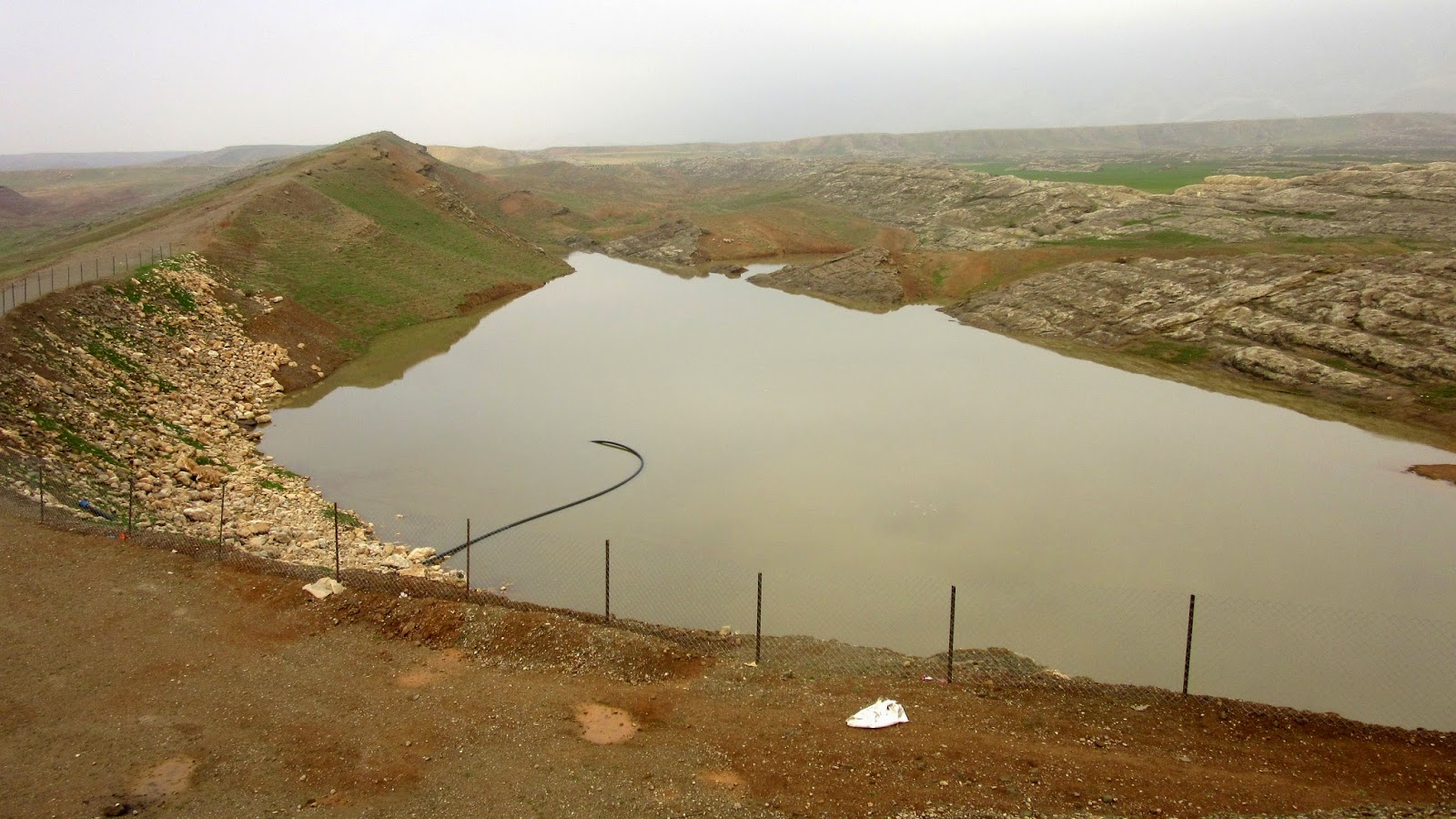
We visited again in February 2015; the weir is 2 meters from its full capacity, and the villagers have installed the fence around its perimeter that they had mentioned wanting in October to protect children and animals from danger.

There has been over a decade of drought in northern Iraq, which has exacerbated the hot and dry summers, lowered the water table, and reduced the productive capacity of crops.  This is compounded by problems caused by the disputes between the Iraq and Kurdistan governments, which has resulted in a reduction of subsidies for farmers and, in 2014, a complete lack of payment by the government for any of the crops that it collected from farmers.  After being denied an entire year's income, it is not surprising that most farmers are skeptical about footing the start-up costs for the 2015 season.  The Kurdish military forces (known as the Peshmerga) also recruit among rural farmers: in one 14-family village, there are 16 men enlisted in the Peshmerga.  This both decimates the available labor market and hamstrings the viability of village life, resulting in mass migration from rural to urban settings. 

A repaired irrigation canal in rural Suleimaniya governorate enabled 25 farmers to plant rice instead of wheat in their collective fields.  With rice selling for ten times as much as wheat on the local market, this water resource provided a substantial improvement in their income generation.  

This picture, taken in August 2014 at the height of the dry season, contrasts irrigated fields with the surrounding landscape.

As Westerners, we often romanticize the rural agrarian life and gloss over the fact that this life is unimaginably difficult in many ways.  Daesh is never very far from the consciousness of these Iraqis, but dry wells, salty soil, dwindling villages, lack of schools, cheap imported vegetables, and government neglect is a direct threat to their livelihoods.  "We want a green economy, not an oil economy," says one participant, "but the government will not help us."

02 February 2015

Reading Jonah in Ninewa

Should I not be concerned about Nineveh, that great city, in which there are more than a hundred and twenty thousand people who do not know their right hand from their left, and also many animals?”

One of the most fascinating things about the ancient Christian communities of Iraq—in my mind, at least—is that they mostly identify not as Kurds or Arabs, but as Assyrians.  This seems curious because ancient Assyria was, by most historical and biblical accounts, the original Evil Empire of the ancient Middle East. From their capital in Nineveh (present-day Mosul, capital of Iraq’s Ninewa governorate and current ISIS stronghold), the Assyrians pillaged and murdered from the Tigris to the Nile.  Other empires did the same, but the Assyrian kings recorded their feats of torture with remarkable thoroughness and glee.  The Babylonians are famous for the Hanging Gardens; the Assyrians are known for mass deportation.   

The Assyrian flag, adopted in 1971.
This way of putting it is a bit hypocritical and condescending –after all, no people group is innocent, so who am I, an American, to question someone else’s far distant ancestors?  My question, I suppose, is a bit more specific.  What is it like to be both Assyrian and Christian, given that being a Christian means reading the stories of ancient Israel? Assyria destroyed the ten northern tribes of Israel and decimated or displaced dozens of other nations.  The Aramaic language came to be widely used across the Middle East in part because the Assyrians forced the Aramean people to scatter in pockets across the Assyrian Empire.  You could say that Jesus spoke Aramaic, and many Christians in Iraq still speak a dialect of Aramaic, because of the state-sponsored terrorism of the ancient Assyrian Empire.  So what is it like for Assyrian Christians to seem themselves portrayed as the bad guys in the Bible? 

I got one very direct answer this week.  Three weeks before the start of Lent, all the traditional Iraqi churches celebrate “The Intercessions of Nineveh,” a 3-day fast and nightly mass to remember not only the story of Jonah but also the prayers of the people of Nineveh to be spared from God’s wrath.  When I read the story, I usually identify with Jonah.  When they read it, they are the Ninevites.   Assyrian identity gets enacted in church as the memory of rescue from their ancestors' ways of murder and domination.  Reading Jonah is a reminder that they were, by the grace of God, saved from being Assyrian—or at least, rescued from what was wrong with being Assyrian. 

This year, the story of Jonah took on a special urgency.  The center of the fight against the Islamic State group is Ninewa governorate and its capital, Mosul.  Just like in the story, it looks like all hell is going to break loose against that city in about six months, as Kurdish Peshmerga forces narrow in, coalition airstrikes intensify, and the Iraqi army completes its training of special brigades to take back the city Forty days more, and Nineveh shall be overthrown!” says Jonah.  ISIS is undoubtedly preparing to make its defense of the city as costly as possible.  Praying an ancient story about the delivery of Nineveh could hardly be more fitting, and more hopeless.  The world’s judgment hangs over Mosul, and this time there is no Jonah.  In any case, it is hard to imagine IS “caliph” Abu Bakr al-Baghdadi in sackcloth and ashes.  But, “who knows? God may relent and change his mind...so that we do not perish.” 

st. joseph church
St. Joseph's church in Ankawa, like many Iraqi churches and Assyrian cultural buildings, is modeled after ancient Babylonian and Assyrian architecture.
But still, the analogy is all wrong here.  Mosul is not Nineveh.  In three thousand years, the barbarity of ISIS won’t be remembered; the American empire will.  I hope our reputation is better than the Assyrians, but either way, a present-day Jonah preaching divine destruction would be heading to Washington, not Mosul.  This wouldn’t be a bad way for American Christians to read Jonah. Who we are in the story makes all the difference, and in this story, I am an Assyrian.
      
These are the things I like to think about.  For the most part, though, I have no idea what real Assyrians think when they hear this story now.  On Wednesday evenings I teach English to high-school students who fled from Mosul and Qaraqosh, a large Christian town just outside Mosul.  Last Wednesday we did an activity with the story of Jonah.  At the end I asked them why Jonah was so angry that God didn’t destroy Nineveh.  “Because of the fish,” said one.  “Because of the plant,” said another.  Wrapped up the in geo-political reading of the story, it had never occurred to me before that Jonah was just tired of being pushed around and manipulated.  Whichever part in the story the people of Mosul have—whether Christians forced from their homes, or Muslims now trapped in them—none of them got to choose.  It is going to be a tough spring.       

30 December 2014

Christmas in Kurdistan


Nathan was a bit worried that showing Home Alone to his students at St Peter's Seminary wouldn't be appropriate for the religious context.  Santa and his reindeer in the seminary lounge did a great deal to allay his fears.


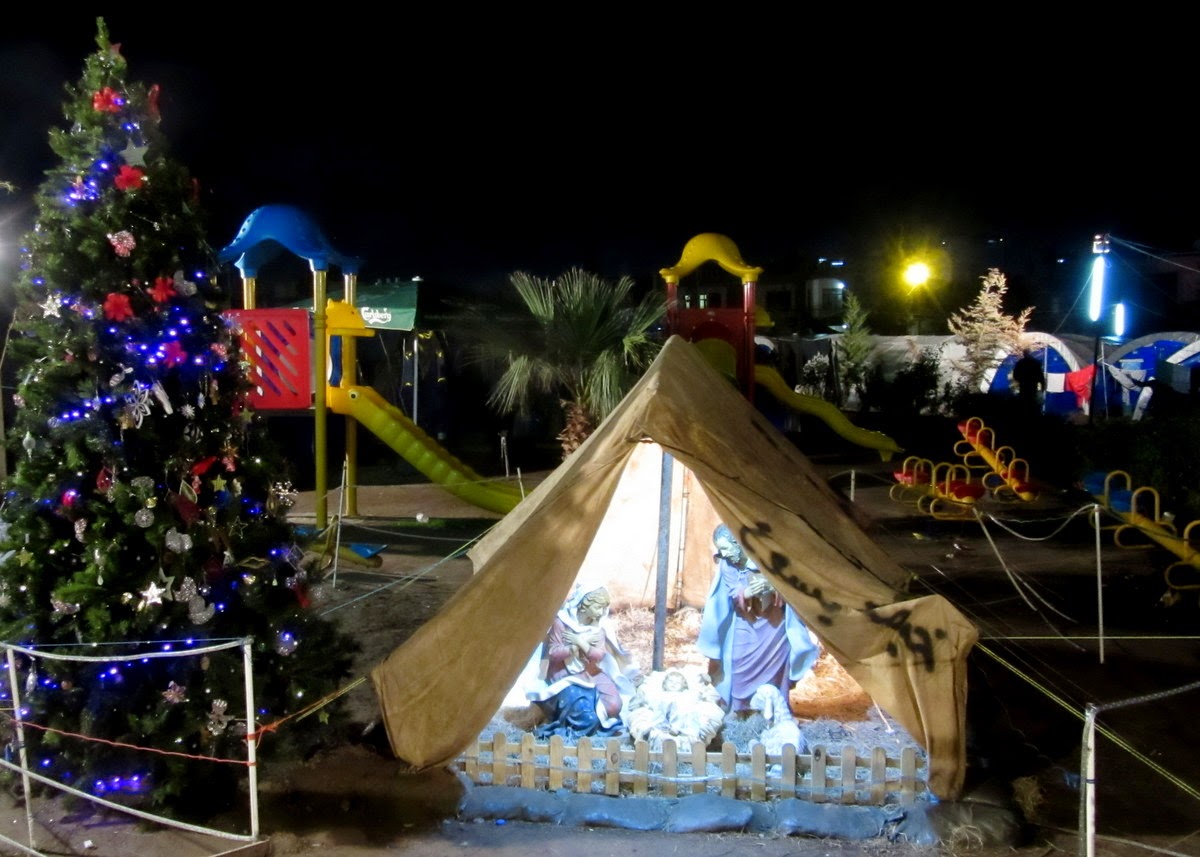
The IDP center at Mar Elia Shrine has this life-sized nativity in one of the tents left over from the early days of displacement.  The writing says khema yesooa (Jesus' tent).

The surroundings of Jesus' tent.


Our Advent wreath on a quiet Christmas eve, pre-service.


Post-service, choir members greeted each other in the newly-renovated sanctuary at Umm al-Maouna church.

Christmas dinner (garlic lamb chops and mashed potatoes!) by the warmth of the Syrian stove.


Nathan divided the pieces in half so that I wouldn't compulsively do it all by myself.


His Christmastime tradition of re-reading The Lord of the Rings continues for another year.
(Not pictured: we also re-watched.)


Christmas crafting.


Christmas goodie-making.


Surprise deliveries from our parents' homes supplemented our array of cookies and sweets with a taste of home. 


Post-Christmas, the remnants of my Advent wreath spiraled out of control.


12 December 2014

The time I met the Patriarch


One of the things I enjoy most in English teaching is the opportunity to introduce my favorite bits of English-speaking culture to a captive audience.  Last Friday afternoon I was sitting in the entrance hall of St. Peter’s Seminary giving a student some ideas for Christmas reading when two men in clerical garb walked into the seminary and sat down on some couches across the room.  I could tell they were important by the hush that preceded them, so I tried to restrain the eagerness in my voice as I discussed the respective merits of “The Lion, the Witch, and the Wardrobe” and “A Wrinkle in Time.”

When the student finally managed to disentangle himself from my childhood reminiscences, one of the two men who had entered the room asked me what I was doing in Iraq.  I explained that I was the English teacher at the seminary and also worked at Mar Qardakh, a church school.  When I told him I was American, he mentioned that he had spent a year living in New York finishing his theological training.  “Americans are warm and generous and sincere,” he said.  I agreed, and then said the thing that liberal American do-gooders abroad are supposed to say, “Yes, but they are ignorant about the world.”  He nodded and replied, “America is all economy and no philosophy.”

Before I left I went over to where he was sitting, shook his hand, and asked his name.  “Louis,” he said.  “I am the head of this Institute.”  When I told him my name, he replied “Oh, the prophet!  And who is your David?”  Not wanting to implicate anyone in murder and adultery, I demurred.  “I don’t know yet.  Maybe I don’t have one.”  As I walked home, I thought, “What a pleasant man.  I wonder what he meant about being the head of the institute?”  

The beautiful grounds of St. Peter's Seminary, just outside Ankawa.  The Seminary relocated from Baghdad to Ankawa in 2007 and 2008 because of instability in Baghdad and targeted violence against Christians.   

The next Monday, I was hanging around the seminary after classes ended early thanks to the Feast of the Immaculate Conception (or “The Feast of Getting Pregnant,” as one of my students put it).   Father Fadi, the rector of the seminary, waved me over to sit by him on a sofa. “This is the Patriarch’s secretary,” he said, pointing to the man beside me, "and in a few minutes, the Patriarch will join us as well."  I tried to act the way I imagine you’re supposed to act around a Patriarch’s secretary.  (Mostly this meant quietly drinking my tea.)  After a few minutes—to my surprise, but probably not yours—the man I had met on Friday walked over and sat down with us.  “Ah, the professor!” Patriarch Louis Sakho said with a wink and a smile as he shook my hand.  

I’m not sure if he was being coy in our earlier conversation, or if he thought I wouldn’t know what a Patriarch was, or if he assumed I would piece together his hints.  At any rate, the Chaldean Patriarch is a warm and generous person, and not lacking in philosophy.  Centralized leadership works well as long as you have the right people in the right places, and it seems like in this case, the Chaldean church does.    

02 December 2014

Routine

Life in Iraq is settling into a fairly regular routine.

As you can see, the work week is generally Sunday-Thursday.  This is complicated by the seminary, which runs Monday-Friday.  To compensate for working on Friday afternoon, we try to take it a bit easy on Sunday afternoon.

Most days Nathan wakes up around 7 and I wake up... later.  We study Arabic together three mornings a week with a book and CD of drills.  (Sometimes this is fun, and sometimes it's frustrating.  Our language skills are improving and we can communicate a surprising amount, but when we don't have a native-speaking teacher correcting us and providing new input, and when most people are just as likely to speak Kurdish, Sureth, or English as Arabic, there aren't a lot of sink-or-swim language learning opportunities.  So we stagnate, and flounder, and make silly mistakes, and gradually internalize verb conjugations.)

DIY Iraqi hipster Christmas tree star.
After Arabic I eat breakfast, shower, check up on the internet world, and usually accidentally start working before 10 am because there are emails in my inbox and I must read them now.  This is okay, because I take breaks during the day to make Christmas decorations (or write blog posts).  I love working at home.

Two days a week, Nathan bikes to Mar Qardakh school, where he tutors students in English in the morning and then collaborates with teachers on writing assignments and grading in the afternoon.

On two afternoons a week, Nathan teaches English to students at St Peter's Seminary.  In one three-hour block he teaches 28 seminarians in three 45-minute classes, with a half-hour break for tea before the last class.

We have choir practice two evenings a week, and we usually have an additional hour of practice prior to mass on Sunday evenings.  Three nights a week is a big time commitment.  So far it's been absolutely worth it, although the list of upcoming choir responsibilities for Christmas is a bit daunting.

--

Lots of things are not included in the schedule above.  There are always meetings, and drop-ins, and sometimes social events.  Nathan has started doing some one-on-one tutoring in addition to his class prep.

Also not included in the formal schedule are the little things that have nonetheless become routine.  At least once a day (or night), we stop whatever we're doing (e.g. sleep), put on shoes, and walk outside because the electricity supply has switched from the neighborhood generator to the national grid, and the surge of power threw the circuit breaker.  Nathan also flips a switch on every day or so to make sure that water is getting pumped from the line up into our roof-top tank, and turns it off once it's full.  (Thanks, dear.)

Once or twice a week, we walk 10 minutes to one of the nearby grocer stands to get fresh vegetables and fruit.  Most of our non-produce groceries come from nearby stores that sell basically everything (coconut milk? check!).  Once or twice a month, we take a taxi to one of the supermarkets in Erbil to get fancy things like cheddar and Parmesan cheese, Kalamata olives, and bulk honey.

The Syrian heater is the Middle Eastern equivalent of a woodstove.  It's cozy.
Every weekend we clean, make granola, and listen to wait wait don't tell me on podcast.  We cook or eat leftovers, and we eat later: lunch at 1 or 2, dinner at 7 or 8.

During or after dinner on quiet evenings, we often watch an episode or movie from our inherited collection of pirated and legitimate DVDs.  Now that it's getting chilly, this routine also includes lighting candles, firing up the kerosene-burning Syrian heater, and sometimes roasting chestnuts or popping popcorn on its cast iron top.

We're usually in bed by 10.